Big Educational Breakthrough:
Accompaniment Teaching for Immigrant Students Works
Everyone who wants to see inclusive education succeed in our schools needs to hear our guest, Enrique Sepulveda, at the May 2, Saturday, 9 am Jubilee Forum.
Imagine the struggles for learning success in bilingual and multilingual schools. Such schools have culturally rich potential for students and faculty, but feel the challenge to achieve good learning results. And that’s a huge challenge. What is expected of our teachers and schools goes well beyond teaching alone.

Enrique Sepulveda
Enrique Sepúlveda is an expert educator with Chicanx/Latinx students. He is the son of Mexican migrant workers from the Texas/Mexican border. In his early career, he worked as a bilingual classroom teacher and school principal in the northern California central valley. These experiences have shaped his lens and motivations to interrogate, examine and dismantle dominant educational structures, narratives and practices around culture, race and language that serve to marginalize and keep students from realizing their full humanity and abilities as learners.
His teaching method is to accompany Chicanx/Latinx peoples, youth and their families, as they negotiate from the bottom up and face difficulty in figuring out who they are in an unfamiliar culture with severe inequality and structures that don’t favor them. His work seeks to understand the student by developing teaching methods that facilitate a deeper understanding of the complex, liminal lives of migrant youth and community.
Jubilee Forums are free and one hour long, so you have most of your Saturday for other plans. If you’ve never participated before, you need to register by sending your intent to lee@jubilee-economics.org. Lee will send you the Zoom link.
Intercultural Theologies in Jubilee Circle, Chiapas, Mexico
So Different from Top-Down Theologies and Western Creeds
The Yobel School in the Jubilee Circle of San Cristobal, Chiapas, brought together representatives from the Indigenous Tzotzil, Tzeltal, Chol, and Tojolabal language communities for two days in March to practice intercultural spiritualities together. Facilitators were in town from the university in Heidelberg, Germany. Volker Küster and Dorothea Erbele-Küster specialize in intercultural spirituality. Your donations to JEM provided the assistance needed for this workshop to happen.
In anticipation of this workshop, Pedro Robledo Ramirez, director of Yobel School and his son Isai, went to an event called “seedbed” (“El Semillero”), organized by the Indigenous Zapatista School. One phrase that caught Pedro’s attention was: “True change will not come from the power of the Nation-State, but from the organization and resistance of communities.” The Jubilee Circles in Mexico fully embrace such a model for change.
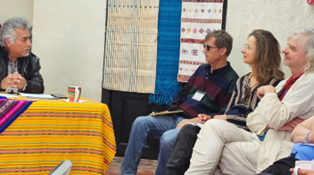
L-R: Pedro, unnamed attendee, the Künsters
In the workshop itself, one participant made the following reflection:
It was deeply interesting to encounter alternative representations of a God who is, fundamentally, the same—yet who reveals different faces across the diverse cultures of the world. It was also significant to acknowledge the lives and service of women within our communities. And, finally, to awaken to the realization that we are one with the earth—that we have a duty to care for it—drawing support from biblical texts read through an ecological lens. —María de los Ángeles Martínez
As Pedro reflected on the event, he wrote:
The Wular wisdom, with the aim of teaching how to live, fostering a vital connection with all of creation. They create a balance of life with rhythms linked to work, hunting, meals, day and night, the sun and moon, rain and drought, birth and death, love and heartbreak, sharing, and the defense of their territory.
Note that the theologies of imperial and superpower cultures commonly lack such understanding of God and life.
Perennial Grains Add to the Grassroots Agricultural Revolution
Strait of Hormuz and Fertilizer Shortage Show that New Way Is Needed
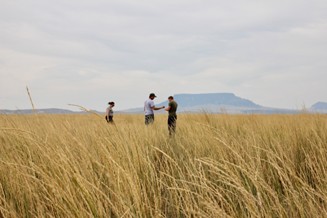
a field of kernza in Wyoming, Courtesy of the Land Institute
With petroleum products pinched off because of the poorly conceived war with Iran, there is a surge in buying electric cars. Could there be a parallel surge among farmers to change to organic and regenerative methods and bid goodbye to massive need for fertilizing crops?
Such a surge would be a great development for soil health, food health, and a much-needed revolution in farming methods away from industrialized agriculture that has become the deeply flawed default system.
A core element going forward in farming regeneratively imitates the prairie grasses which grow perennially without tilling or fertilizing. The Jubilee Forum on April 4 hosted Michael Johnson of Perennial Films and their new cutting-edge release “Prairie Prophecy” on the work Wes Jackson pioneered at the Land Institute, Salina, Kansas. The Institute has produced a new perennial grain, the kernza grain which is marketed in various products and being continually bred to increase its yield. PBS is showing this film on stations across the country. You can hear a recording of this Forum by requesting it in a message to lee@jubilee-economics.org.
“A visually striking film that pairs masterful storytelling with Wes Jackson’s visionary ideas – offering an engaging look at the past and future of agriculture.” —VALERIE M.B. VANDERSLUIS, KTWU
Invest with Jubilee with Confidence of Good Returns
Let’s call our donations investments? Please invest in OneEarth spiritualities and practices with payments to Jubilee Economics Ministries. Good returns on your investments are assured in the stories emanating form all four Jubilee Circles. Currently, over sixty investors receive these benefits. Please consider making Jubilee Economics Ministries a part of your “portfolio.” Your investment can be made online, with a check in the mail, from IRA distributions, donor-advised charitable trusts, or shares of stock. Thanks for trusting our Jubilee Circles with your investment in ministries in Tapachula, Chiapas; San Cristobal, Chiapas; San Mateo, Puebla; and San Diego, U.S.