Welcome to the Power of the Margins
Jubilee in a Time of Collapse
What Does “Collapse Acceptance” Mean?
Cosmologist Brian Swimme considers “cosmogenesis” one of the ten most important discoveries in the human story—more important than Copernicus. Cosmogenesis describes how the cosmos generated life over the past 14 billion years and how she continues to do so now. This awesome capacity of the cosmos is described by Swimme in terms of 11 powers of the Universe, one of which is cataclysm. That power is much in evidence today amid mass extinctions, a seriously destabilizing climate, and general breakdown of systems that have ordered life since the dinosaurs. The geologists call this era “Cenozoic.” Swimme says bluntly, “The Cenozoic Era has ended.”
 Lauren Van Ham, eco-minister and Earth Restoration Coordinator with the global United Religions Initiative, was guest presenter at the February Jubilee Forum. She spoke of her own work with collapse acceptance and her recent time spent with Brian Swimme and others. Cosmogenesis understands that for the next age of Earth to be born, 96% of life forms in the Cenozoic must die. This is standard in geological history. Beyond the Cenozoic the Ecozoic is being born.
So much more was discussed in this rich, rich Forum. If you request it, we can send you a recording.
Collapse is like what happens in the cocoon of metamorphosis. There’s a mighty struggle between cells wanting to be caterpillar and seminal cells wanting to be some new form of life. Jubilee’s mission is to be among the many seminal cells, cells from among the margins that are integral to the cosmogenesis that leads us into the Ecozoic Era.
Jubilee at the Margins in Puebla, MX
Jubilee is dismissed and resisted by the powers of this world, but people on the margins of societies embrace it and bring it to life. The Mexico Circles exemplify this well. The San Mateo Jubilee Circle, in the state of Puebla, is not at the center of power in the state, but in a community of strugglers. San Mateo exhibits many of the issues that arise in communities neglected by the powerful. How then does the Circle there go about ministry? What is working effectively and where are the struggles?
 Answers to these questions will be shared at the March 7, Jubilee Forum! Angelica Juarez, David Delgado, Karina Velez, and Mariana Velez will be guests at this Forum, 9 am PST, and we can hear from the San Mateo Jubilee Circle in their own words.
Register for this great Jubilee Forum on March 7, 9 am PST by sending a note to lee@jubilee-economics.org. (Photo: Mariana Velez and David Delgado)
More Great Forums Coming in 2026:
April 4 – Michael Johnson, producer of “Prairie Prophecy,” an award-winning film on regenerative agriculture and Wes Jackson, founder of the Land Institute, Salina, Kansas.
May 2 – tentative —an Indigenous woman raises up the rising influence of Indigenous peoples and the importance of their culture and way of life amid ecological breakdown.
Jubilee Innovates Training in Progressive Theology on the Margins
The Yobel School, Chiapas, directed by Pedro Robledo Ramirez and part of the San Cristobal Jubilee Circle, cooperates with a wide range of institutions to deliver “contextual formation for the people of God.” The phrase “contextual formation” emphasizes that the courses taught consider first of all the context in which the subject matter will be used in practice. Typically, the participants are serving people too marginalized to be part of any major urban congregation. The work of Yobel is …
- teaching-learning directly with participants,
- writing for publications that emphasize theology in service of the poor, and
- teaming with many others doing this kind of ministry in Latin America.
Examples of Pedro’s teaching and writing in recent months follow:
Teaching
- Biblical Workshop with Dr. Corinne Lanoir on the topic: Contextual Reading of Ecclesiastes. The Bible workshop was organized in conjunction with the University of Chiapas-Christian University (UDECH) and was
 held at its campus in Tuxtla Gutiérrez. UDECH operates in six locations to make training more accessible.
 - Course on Deuteronomistic Literature for a group of UDECH students via the Moodle learning platform.
- Course on Biblical Theology for a group of 7th-semester students in the Bachelor of Theology program at UDECH.
Note: Photo of Pedro with the new computer, which JEM helped him acquire in the emergency when his previous computer died. So much of Pedro’s work is computer dependent. Thanks, donors for helping this happen.
Writing
- “Follow-up and Witness: The Rhetorical Structuring of the Gospel According to John,” forthcoming in the Latin American Journal of Biblical Interpretation (RIBLA) No. 97-2025/3:11-43, Quito, Ecuador. The RIBLA journal presents articles from a variety of Latin American authors presenting the Bible in various contemporary settings.
- “The Prophetic Role of Jesus in Luke,” in the journal Argumenta Bíblica Theologica, No. 10, Vol. 5 (2024): 41-70, published by the Claretian University.
Pedro writes: “We thank the merciful God of life for accompanying and blessing us, and Jubilee Economics Ministries (JEM) for their financial support in purchasing new computer equipment and for the monthly redistribution to our biblical training ministry in and from Chiapas. Trusting in divine provision and guidance, we renew our vision and mission to continue promoting the imagery of the biblical jubilee and to successfully advance our program goals for the new year.”
Na’Xojobal Jubilee in San Cristobal is Organizing
“Peace Processes in the Midst of Violence” Actions for 2026
The situation of violence in San Cristóbal de las Casas, Chiapas, is complex and layered, touching many areas of community life. In response to this reality, Na’Xojobal Jubilee began, on January 20, 2026, a year-long journey of twelve monthly workshops, from 10-2pm, titled “Peace Processes in Situations of Violence.” The intention is to create an ongoing space for reflection, learning, and collective action toward peace.
Thirty-two participants gathered for the first session, representing community collectives, civil organizations, and an independent workers’ union. Each participant brought the perspective of their own work, united by a shared commitment to fostering reconciliation and peace throughout the region.
Various Expressions of Violence between People
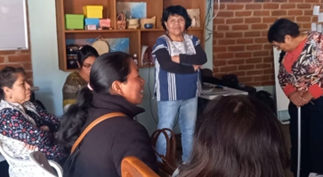 This opening workshop introduced peace-building through dialogue and reflection. It became a space of honest exchange, where participants shared lived experiences and explored essential concepts such as reconciliation, forgiveness, justice, and Jubilee. Working together, they reflected on how building collective action can move communities closer to a more just and equitable society. (Photo of Gloria Gonzalez and just a few of the participants.)
After the reflection, participants worked in small dynamic groups examining how peace is intertwined with justice and liberation. Each group focused on a particular expression of violence affecting the community.
- Conversations addressed the alarming prevalence of gender-based violence, including femicide, disappearances, and sexual assault.
- Others explored the painful reality of domestic violence impacting women and children.
- Another group reflected on violence linked to organized crime — including the presence of groups locally known as “motonetos,” whose activities have caused fear and forced displacement.
Participants also confronted the enduring discrimination and violence faced by Indigenous peoples, recognizing the deep historical roots of these injustices for 500 years since the Spanish invasion.
Violence Against Mother Earth
Environmental concerns formed another vital part of the dialogue. The climate crisis was described as a cry from Mother Earth, a sign of violence against the environment. Participants considered how the exploitation of natural resources affects Indigenous communities and threatens the fragile wetlands that remain in the area. Related discussions highlighted the risks, violence, and repression faced by environmental defenders in Chiapas, framing these struggles and attacks as matters of justice.
Underlying Forces that Sustain Violence
As the workshop drew to a close, a community conversation identified underlying forces that sustain violence in the municipality: economic and social inequality, which deepens vulnerability and conflict, and government corruption and complicity that allow organized crime to flourish.
The workshop closed with a reflection of the importance on reconciliation and forgiveness among our groups and collectives working toward the same vision, LEKIL KUXLEJAL, or “Good Living.” Participants reflected on healing collective wounds and nurturing peace from within their relationships and communities from reconciliation and forgiveness.
The next workshop in this continuing series will take place on February 27 at EduCreando in Colonia Maya, marking another step in this ongoing commitment to dialogue, healing, and peacebuilding.
—Na’Xojobal Jubilee, San Cristóbal Circle, Chiapas, Mexico
Why Jubilee’s 25th Anniversary Fund Drive Is Needed
Jubilee Circles Need an Infusion of Money
In Jubilee we so often don’t do things in the usual way. For example, it’s quite common for organizations to start a major fund drive having already gained commitments for some large donations. But Jubilee’s 25th Anniversary Fund has been launched with donations of $100 and $200. It’s a bit laughable compared to the end result for Phase One, which is $133,000.
Why do we need these extra funds? The best short answer is that over 25 years the steady flow of donations has resulted in outgrowing our “wardrobe.” So we begin with the San Cristobal Circle. Their three major ministries (with many sub-ministries) have never had a home. They’ve never had a Center. They have bounced around for the best rent deals. They find one, but soon have to move on. Phase One of this fund drive will give them land and a Center. Plus, Phase One will benefit San Mateo Circle as well. They have a Center, but the kitchen needs a new roof, and their youth ministry needs a space that is theirs.
We are soliciting foundations and larger money sources, so the burden isn’t all on just those of us who are less-monied. But small donations, as the first two illustrate, are needed, and needed from many donors.
One request. If you already donate to Jubilee, any donations to this Special Fund need to be beyond your usual donations to Jubilee. If all we do is switch our donations from our usual giving, you can see that we’d be shooting ourselves in the foot.